
Project Summary and Challenge
A glass services company in Ohio offered over 1,000 different glass profiles requiring careful handling, edge seaming, and loading onto the production line. For years, this customer relied on manual labor to unload glass from storage racks, seam all edges, and stage pieces for production. As product offerings expanded and demand increased, the operation struggled to keep pace, frequently requiring extra shifts to meet deadlines. Their existing dry seaming equipment also produced lower-quality edges, but transitioning to wet seaming was not feasible with human operators due to safety concerns.
To remain competitive and ensure long-term operational sustainability, the company partnered with Premier Automation to design a modern robotic rack-unload and seaming system engineered to reduce scrap, improve seam quality and consistency, enhance operator safety, and maintain reliable throughput.
The Problem
This customer’s legacy seaming process created compounding operational challenges that became increasingly difficult to manage as production demands grew.
Seaming is intended to remove sharp edges created during CNC cutting, but maintaining consistent quality under production pressure proved difficult. Operators frequently had to work quickly to maintain throughput, resulting in edges that were partially or insufficiently seamed. Manual unloading also demanded extreme care to avoid glass breakage, and under production pressure, that level of precision was hard to sustain, driving elevated scrap rates.
Labor shortages added another layer of complexity. Because this seaming operation represented only one segment of a broader production line, the company was frequently forced to pull workers from other areas to cover large glass pieces that required multiple operators. The cumulative effect was a process that could not scale without significant risk to quality, safety, and output.
The Solution
Premier Automation engineered a fully integrated robotic seaming system capable of unloading glass from any of this customer’s six rack styles and seaming each piece using a wet seamer. The solution was designed to address quality, throughput, and safety simultaneously, with the engineering depth to handle the full complexity of 1,000-plus glass profiles in a single automated workflow.
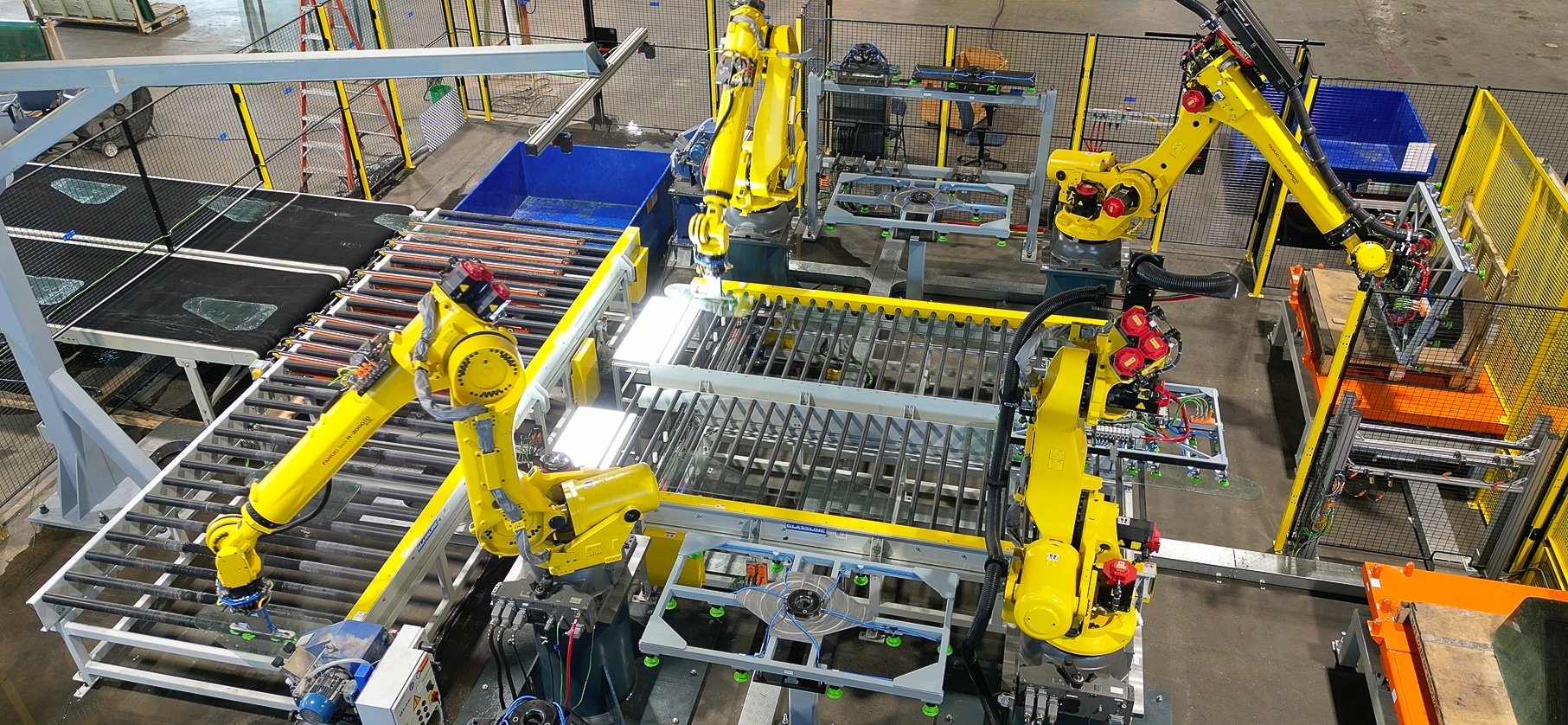
- Robotic Handling: Four FANUC R-2000 robots were deployed: two equipped with suction-cup arrays to unload any glass profile across this customer’s full product range, and two fitted with tool-change parents to interface with six custom end-of-arm tools for picking and seaming operations.
- Integrated Vision: Two Keyence VS cameras were incorporated to locate and identify glass edges, ensuring accurate positioning and consistent seaming paths across every part.
- Streamlined Teaching Process: A semi-automated teaching workflow was developed through the HMI, enabling new parts to be taught in under 10 minutes and minimizing production downtime when new parts need introduced to the system.
- Automated Workflow: Turntables allow parts to be queued for continuous operation and simplified changeover between glass profiles, supporting uninterrupted throughput.
- Remote Diagnostics: The system includes remote monitoring capabilities to reduce downtime and support efficient troubleshooting without requiring on-site intervention.
The Results
The robotic seaming system transformed this customer’s production operation, delivering measurable improvements across quality, throughput, and safety.
- Waste Reduction: Scrap rates decreased significantly due to precise robotic unloading and consistent seaming paths, reducing the material losses that had compounded under manual handling.
- Increased Throughput: Medium and large parts are now seamed faster than operators could previously achieve, while small parts maintain equivalent cycle times. The operation no longer depends on extra shifts or labor reassignment to meet production targets.
- Improved Quality: Glass exits the system with consistent, high-quality seams on every piece. The transition from dry to wet seaming delivers a superior finish that was not safely achievable with manual operators.
- Enhanced Safety: Operators no longer handle sharp, unpredictable glass pieces directly. The move to wet seaming also reduces airborne particulate, improving overall air quality throughout the work environment.
 >
>
Driving the future of manufacturing through collaboration
Premier Automation is a proud member of the ARM (Advanced Robotics for Manufacturing) Institute. The ARM Institute aims to be the leading catalyst of robotics innovation and expertise and to accelerate growth in US-based manufacturing and the high-value careers that go arm in arm with this industry change. ARM is dedicated to creating the ecosystem that will drive innovation in robotics.
Premier Automation is an Authorized System Integrator for:

Robotics

Electric