
Project Summary
A material services company located in Michigan required a more reliable and efficient solution for plastic shaping. For years, its operations relied on precision shaping processes to convert raw plastic stock into critical components for downstream manufacturing. However, outdated equipment required frequent operator oversight, lengthy manual changeovers, and offered limited automation, leading to high scrap rates.
As the production demands grew, the limitations of the legacy system began to hinder efficiency and reliability. To remain competitive and ensure long-term sustainability, the company partnered with Premier Automation to design a modern robotic shaping cell. This new solution was built to increase throughput, reduce waste, and create a safer, more streamlined production environment.
The Challenge

The company’s legacy shaping system created significant operational challenges:
- Time-Consuming Changeovers: Mechanical adjustments for different part sizes often required several hours.
- High Scrap Rates: Variations in stock thickness made it difficult to center the bullnose profile accurately, resulting in wasted material.
- Limited Capacity: The block holder magazine could accommodate only a small number of parts, necessitating constant attention from operators.
- Obsolete Equipment: Aging equipment that was built overseas was challenging to maintain due to limited access to spare parts and technical support
- Inefficient Drilling Process: Parts were transferred to a separate drill station for countersink and through holes, which also required fixture changes based on part size, slowing production.
- Poor Chip Management: Design issues led to excessive chip buildup, increasing cleanup time and disrupting operation.
- Labor-Intensive Management: Meeting production demands required six days of labor.
The Solution
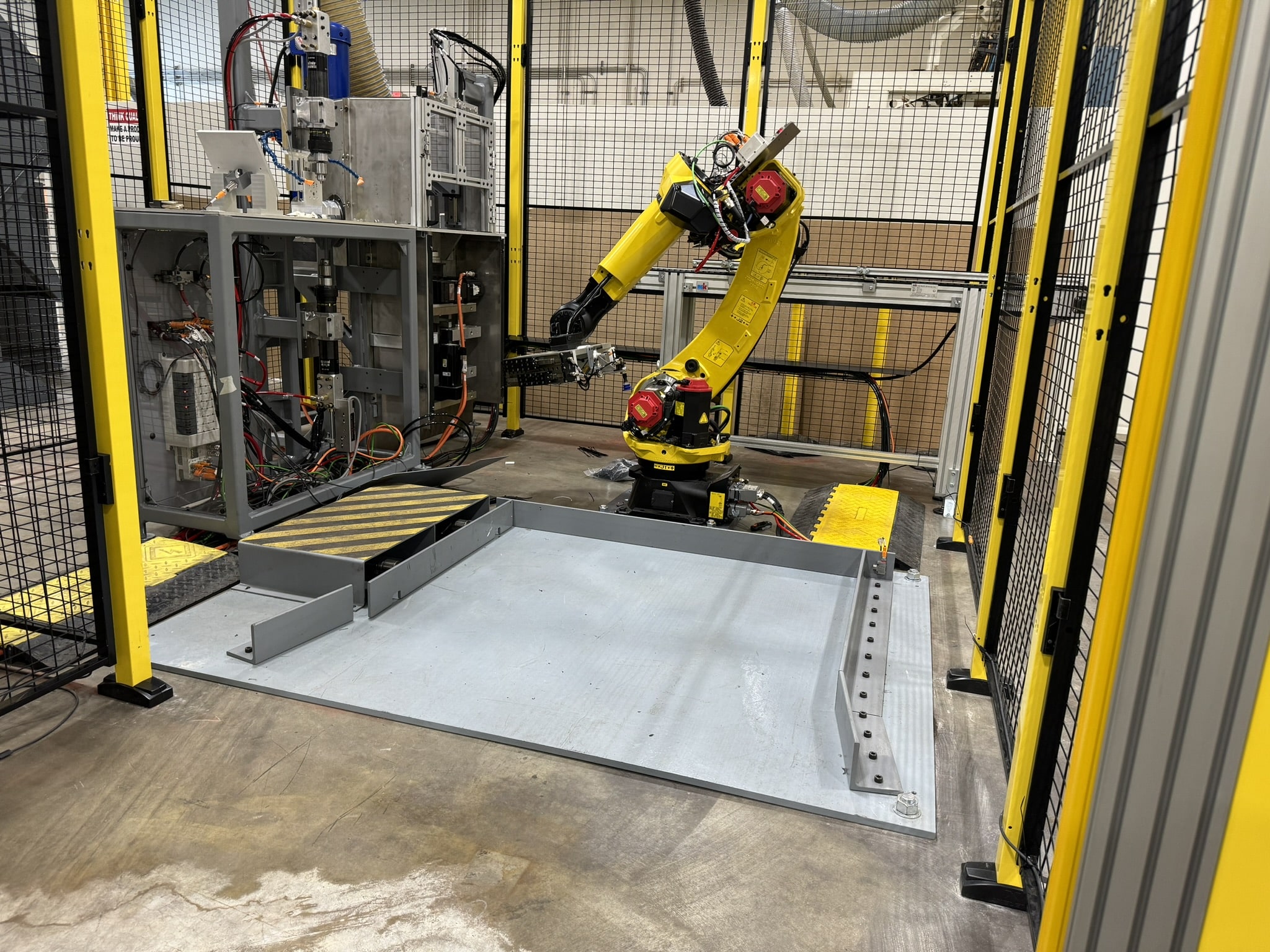
To address these challenges, Premier Automation partnered with the material services company to engineer a fully integrated robotic shaping cell designed for precise drilling and shaping that improved safety, streamlined workflow, and decreased scrap rates.
- Robotic Handling: A Fanuc M-10 robot with custom end-of-arm tooling (bi-parting grippers, vacuum cup, and laser sensor) for accurate, flexible part handling across multiple stock sizes
- Integrated Drilling & Shaping: A dual-drill arrangement for simultaneous countersink and through holes, paired with a custom shaping unit that clamps and rotates stock against a bullnose cutter for precise profiling
- Enclosed Cutter Design: A secure housing with access doors for chip containment, creating a safer and cleaner work environment
- Automated Workflow: An outfeed conveyor and palletized infeed allow continuous operation for hours with minimal operator intervention
- Remote Diagnostics: The system includes remote monitoring to minimize downtime and streamline troubleshooting
The Results
- Accelerated Production: The operations now meet demand in 4 days instead of 6, increasing overall throughput and capacity
- Waste Reduction: Decrease in scrap rates thanks to precise servo-controlled shaping, improving material utilization
- Rapid Changeovers: Setup adjustments that once required hours are now complete in seconds through the HMI, boosting responsiveness
- Operational Reliability: The system simplifies maintenance and minimizes downtime risk
 >
>
Driving the future of manufacturing through collaboration
Premier Automation is a proud member of the ARM (Advanced Robotics for Manufacturing) Institute. The ARM Institute aims to be the leading catalyst of robotics innovation and expertise and to accelerate growth in US-based manufacturing and the high-value careers that go arm in arm with this industry change. ARM is dedicated to creating the ecosystem that will drive innovation in robotics.
Premier Automation is an Authorized System Integrator for:

Robotics

Electric